| Author | Message | ||
     Lau Kai Kwong Username: lkk Registered: 04-2003 |
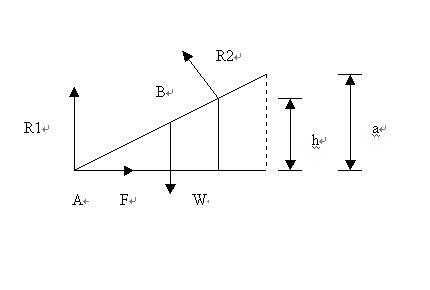
A uniform rod AB of length 2a and weight W is inclined at 30° to the horizontal with its lower end A on rough horizontal ground, the angle of friction being 30°. The rod rests in contact with a smooth peg C (AC < AB). Calculate the height of the peg above the ground and the reaction at the peg if the rod is in limiting equilibrium. | ||
| 961183 Username: 961183 Registered: 04-2003 |
At limiting equilibrium, F = R1tanλ = R1tan30° = (√3/3) R1 Resolve forces vertically, W = R1 + R2cos30° = R1 + (√3/2)R2 … (1) Resolve forces horizontally, F = R2sin30° = 1/2 R2 height of the ladder = (2a)sin30° = a | ||
| 961183 Username: 961183 Registered: 04-2003 |
Let h be the height of the peg By similar triangle, 2a/a = AB/h AB = 2h Take moment about center of gravity, (a)R1cos30∘= (a)Fsin30∘+ R2(2h – a) (√3/2)R1(a) = (√3/6)R1(a) + R2(2h – a) (√3/2)R1(a) = (√3/6)R1(a) + (2√3/3)R1(2h – a) (√3/2)(a) = (√3/6)a + (2√3/3)(2h – a) 3√3(a) = √3(a) + (4√3)(2h – a ) 2h = (1/4√3)(6√3)(a) h = (3/4)a From (1), W = (3/2√3 )R2 + (√3/2)R2 2√3 = 3R2 + 3R2 R2 = (√3/3)W | ||
| 961183 Username: 961183 Registered: 04-2003 |
 | ||
| 961183 Username: 961183 Registered: 04-2003 |
 | ||
| 961183 Username: 961183 Registered: 04-2003 |
Take moment about center of gravity, (a)R1cos30° = (a)Fsin30° + R2(2h – a) (√3/2)R1(a) = (√3/6)R1(a) + R2(2h – a) (√3/2)R1(a) = (√3/6)R1(a) + (2√3/3)R1(2h – a) (√3/2)(a) = (√3/6)a + (2√3/3)(2h – a) 3√3(a) = √3(a) + (4√3)(2h – a ) 2h = (1/4√3)(6√3)(a) h = (3/4)a From (1), W = (3/2√3 )R2 + (√3/2)R2 2√3 = 3R2 + 3R2 R2 = (√3/3)W | ||
| Lau Kai Kwong Username: lkk Registered: 04-2003 |
It should be AC=2h and AB=2a. Besides, you would better take moment at the point where the most number of forces intersect. For example, you can take moment at A to find R2 directly. Anyway, a good job. | ||
| 961183 Username: 961183 Registered: 04-2003 |
我明白了﹗多謝你的提點﹗ |