| Author | Message | ||
     Lau Kai Kwong Username: lkk Registered: 04-2003 |
A uniform ladder is placed with its foot on horizontal ground and its upper end against a vertical wall. The angle of friction at both points of contact is 30°. Find the greatest possible inclination of the ladder to the vertical. Please post your solution. | ||
| Lau Kai Kwong Username: lkk Registered: 04-2003 |
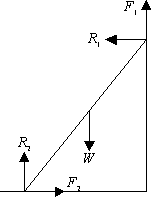 | ||
| 971142 Username: 971142 Registered: 04-2003 |
Resolving horizontally, R1 = F2 Resolving vertically, F1 + R2 = W F1 = R1 tan30° F2 = R2 tan30° (√3) F1 = R1 (√3) F2 = R2 ∴ (√3) F1 = F2 let the inclination of the ladder to the vertical be θ, F2 / F1 = tanθ Then, θ= 60° | ||
| Lau Kai Kwong Username: lkk Registered: 04-2003 |
Why F2 / F1 = tan q ? This step seems to be incorrect. | ||
| 971142 Username: 971142 Registered: 04-2003 |
incorrect ar? so i dunno how to do wor | ||
| 971142 Username: 971142 Registered: 04-2003 |
Let l be the length of the ladder, By conservation of moment, (R1+F2)cosθ(l /2) = (R2-F1)sinθ(l /2) Tanθ = (R1+F2)/ (R2-F1) After solving, Tanθ = √3 θ= 60° | ||
| Lau Kai Kwong Username: lkk Registered: 04-2003 |
Okay. But you should state where you take the moment, e.g. by taking moment at the centre of the ladder. The other thing is ... you jump too many steps! | ||
| 971142 Username: 971142 Registered: 04-2003 |
i didn't jump steps ar u need to combine all the things i posted ga |